
How to Build Multi-Tenant Kubernetes on AWS EKS with Helm & Kustomize (Real-World Architecture)
This architecture demonstrates how to build a scalable and cost-optimized multi-tenant Kubernetes platform on AWS EKS.
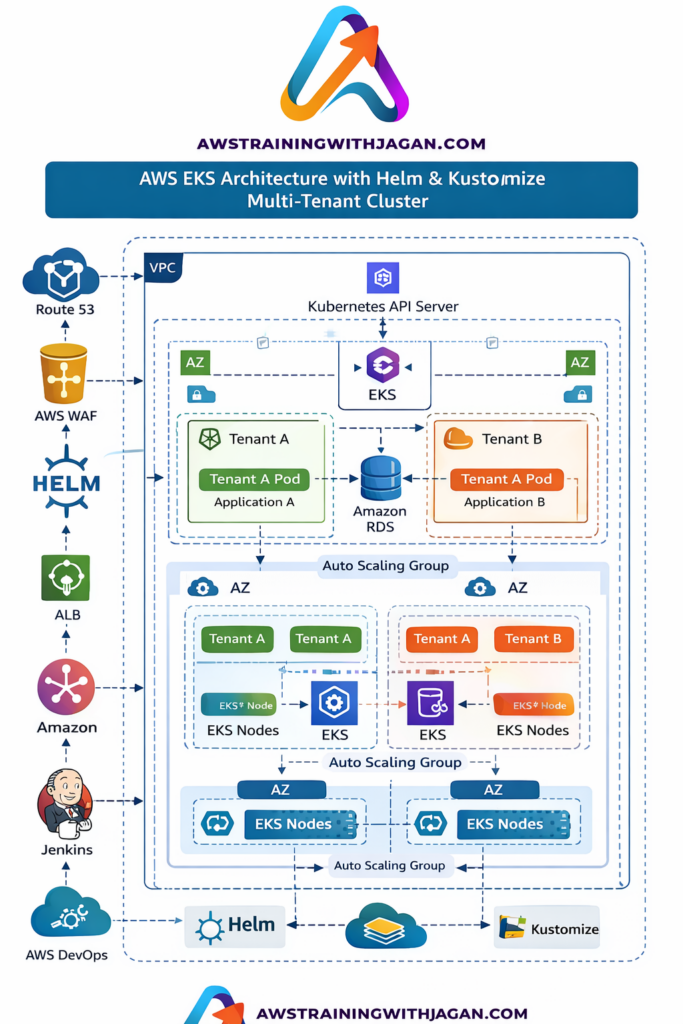
It is deployed inside a secure VPC across multiple Availability Zones, ensuring high availability and fault tolerance.
The EKS cluster acts as the central control plane, while worker nodes are managed via Auto Scaling Groups.
Multiple tenants (Tenant A & Tenant B) are isolated using Kubernetes namespaces, RBAC, and network policies, enabling secure workload separation within a single cluster.
For deployments, Helm is used to package and standardize applications, while Kustomize handles environment-specific configurations like dev, QA, and production.
The CI/CD pipeline (via Jenkins or AWS DevOps) automates deployments, ensuring faster and reliable releases.
Incoming traffic flows through Route 53 → AWS WAF → ALB → Kubernetes Ingress → Services → Pods, providing secure and efficient routing.
Amazon RDS is used as a backend database, integrated securely with the cluster.
This architecture is ideal for SaaS platforms, enterprise applications, and shared infrastructure models, where scalability, security, and cost efficiency are critical.
Modern cloud platforms demand scalability, isolation, and automation—especially when multiple applications or customers share the same infrastructure. This blog explains a production-grade multi-tenant architecture on AWS EKS, powered by Helm and Kustomize, designed for SaaS and enterprise platforms.
What is Multi-Tenant Architecture in EKS?
A multi-tenant EKS cluster allows multiple applications (or customers) to run on a single Kubernetes cluster while maintaining logical isolation.
✔ Benefits:
- Reduced infrastructure cost
- Efficient resource utilization
- Centralized management
- Faster deployments
High-Level Architecture Overview
This architecture is deployed inside a secure AWS VPC across multiple Availability Zones for high availability.
Key Layers:
- Networking Layer: VPC, Subnets, Security Groups
- Compute Layer: EKS Cluster + Auto Scaling Nodes
- Application Layer: Tenant-specific workloads
- CI/CD Layer: Jenkins / AWS DevOps
- Deployment Layer: Helm + Kustomize
1. Secure VPC & Multi-AZ Deployment
- EKS cluster runs inside a private VPC
- Worker nodes are distributed across multiple AZs
- Ensures fault tolerance and high uptime
2. Amazon EKS Cluster
- AWS manages the control plane (API Server)
- Worker nodes run in Auto Scaling Groups
- Supports both:
- EC2-based nodes
- Fargate (serverless option)
3. Multi-Tenant Design (Namespace-Based Isolation)
Each tenant (e.g., Tenant A, Tenant B) is isolated using:
🔹 Kubernetes Namespaces
- Logical separation of workloads
🔹 RBAC (Role-Based Access Control)
- Restricts access per tenant
🔹 Network Policies
- Controls communication between tenants
This ensures secure and independent execution within the same cluster.
4. Helm for Application Deployment
Helm acts as the package manager for Kubernetes.
Benefits:
- Reusable application templates
- Version-controlled deployments
- Easy rollback support
Example:
helm install tenant-a-app ./chart
5. Kustomize for Environment Customization
Kustomize enables environment-specific configurations without modifying base YAML files.
Use Cases:
- Dev / QA / Production overlays
- ConfigMap & Secret variations
- Resource scaling adjustments
Example:
kubectl apply -k overlays/prod
6. CI/CD Pipeline Integration
A typical pipeline (Jenkins / AWS DevOps):
- Code pushed to Git
- Pipeline triggered
- Build Docker image
- Push to ECR
- Deploy via Helm
- Apply Kustomize overlays
Enables fully automated deployments
7. Traffic Flow & Ingress
Incoming traffic follows:
Route 53 → AWS WAF → ALB → Kubernetes Ingress → Services → Pods
Components:
- Route 53: DNS routing
- AWS WAF: Security filtering
- ALB: Load balancing
- Ingress Controller: Routes traffic to services
8. Database Layer (Amazon RDS)
- Centralized relational database
- Secure connectivity from EKS
- Supports:
- Multi-AZ failover
- Automated backups
9. Monitoring & Observability
- Amazon CloudWatch → Logs & metrics
- Prometheus + Grafana → Advanced monitoring
- Alerts for:
- Pod failures
- CPU/Memory spikes
10. Auto Scaling & Performance
- Horizontal Pod Autoscaler (HPA)
- Cluster Autoscaler
- Ensures:
- High performance
- Cost efficiency
Real-World Use Cases
✔ SaaS Platforms (multi-customer apps)
✔ FinTech / EdTech platforms
✔ Enterprise shared infrastructure
✔ Microservices-based applications
Best Practices
- Use separate namespaces per tenant
- Apply resource quotas & limits
- Enable network policies
- Use IAM Roles for Service Accounts (IRSA)
- Monitor using CloudWatch + Prometheus
Conclusion
This AWS EKS multi-tenant architecture with Helm and Kustomize provides:
✔ Scalability
✔ Security
✔ Automation
✔ Cost optimization
A perfect foundation for building modern cloud-native SaaS platforms